25 Jun Why do your CPA and business broker see the same tax return differently?
If you’ve worked with a good CPA for years, you trust them and for good reason. They know your business, have kept you out of trouble with the IRS, and have probably saved you real money along the way.
But there’s one question your CPA rarely asks, and that is: What happens when you want to sell? It’s simply not their job to ask that question.
That’s where a business broker’s perspective deviates from your accountant’s and nowhere is that gap more visible than in the choice between filing an IRS Schedule C (Form 1040 Schedule C) and electing S-Corporation status for your LLC and filing an IRS Form 1120-S.
Two Different Lenses, One Set of Financials
Your CPA is optimizing for your current-year tax liability. They look at your business’s earnings, gross profit and net profit, and ask: how do we minimize what you owe this year, within the rules?
A business broker looks at the same return through a different lens. They ask: how will a buyer read this? How will a lender underwrite it? Does it tell a clear, credible story about what this business earns and what it owns?
Those are genuinely different questions, and they often lead to different answers.
Why is an 1120-S Preferred for Selling a Business?
A Schedule C isn’t wrong. For a sole proprietor or a small owner-operated business, it may be perfectly appropriate from a tax standpoint. There are also certain circumstances when a limited liability company or LLC is ineligible to elect to file as an S-Corporation, but when an LLC does have this option, the Schedule C has real limitations from a transferability perspective.
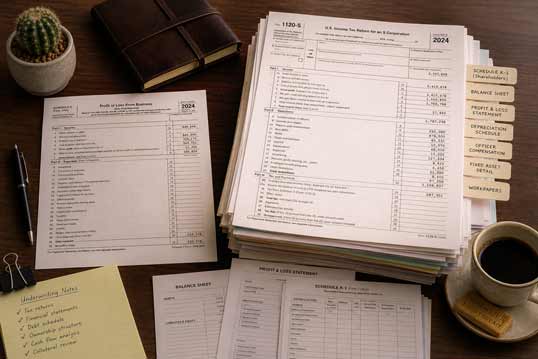
A Schedule C is thin. It shows revenue, expenses, and net profit, but doesn’t include a balance sheet, depreciation schedule with details on the business’s hard assets, and doesn’t explicitly separate owner compensation from the business’s profit. The result is that a buyer or lender has to work harder to reconstruct what the business actually looks like underneath.
That extra work creates friction, and that friction can slow things down, raise questions, or erode confidence in the numbers.
We’ve worked on deals where the partners of a mid-sized businesses were advised to each file their own Schedule Cs. The tax rationale made perfect sense. One business had no employees, carried minimal assets, and took the net profit through owner draws. More importantly, skirting around officer compensation (W2 wages) minimized their administrative and tax burden. Regardless, the resulting financial picture was fragmented, and it made it harder to present the business to buyers and lenders. Instead of a consolidated, well-structured view of the entity’s tax situation, there were just two thin Schedule Cs.
What Does an 1120-S Do Differently?
When an LLC elects to be taxed as an S-Corporation, it files a Form 1120-S. That return produces a materially richer picture of the business.
There’s a balance sheet, reconciliation of book income to taxable income, and a depreciation schedule. The latter shows what hard assets the business owns, when these assets were put into service, and what their current depreciated value is. Officer compensation appears as a standalone line item, separate from distributions and the business’s profit. The K-1 Schedules show ownership percentages and how income (pre-tax net profit) was split.
For anyone trying to understand what they’re buying, that structure is considerably easier to work with. The story of the business is legible, the numbers hold together, and the owner’s economic position are visible.
Because most small business acquisitions are financed through SBA loans, the way an SBA lender evaluates your tax returns often becomes the way a buyer evaluates your business. SBA lenders work with 1120-S returns regularly and have established processes for underwriting them. A Schedule C, particularly for a larger or more complex business, requires more interpretation. When the picture isn’t clear, lenders don’t always give sellers the benefit of the doubt.
The perception isn’t that Schedule C filers are unsophisticated. It’s that at a certain scale, the Schedule C no longer adequately conveys the complexity of the business. The tax return is often viewed as a reasonable, if imperfect proxy, for operational maturity.
What We’re Not Saying
This isn’t an argument that your CPA is wrong. Tax strategy is their domain, and the decisions they’ve made around your entity structure may be entirely sound for your current situation. Filing an 1120-S is not appropriate for every business, and a Schedule C can make sense for many sole proprietors and very small businesses. Moreover, tax savings shouldn’t be sacrificed solely to make a business easier to sell.
What we are saying is that it’s a conversation worth having with your CPA. It’s worth asking them whether your current tax structure makes sense if selling the business is on the horizon. Filing an 1120-S does not make your business worth more, but it may make your business more legible and easier to evaluate.
If you remember only one idea from this article, let it be this: your tax return doesn’t just convey information to the IRS. It also communicates with future buyers, SBA lenders, and everyone involved in evaluating your business. Choosing the right tax structure isn’t only about today’s tax bill, but may also end up affecting how easily a buyer or underwriter can understand – and feel comfortable with – what your business is worth.
Sam Goldenberg & Associates has been helping New Mexico business owners navigate the sale process since 1983. If you’re thinking about your exit, even if it’s years away, we’re happy to talk.
Additional Reading
If you want to explore transitioning out of your business, here are some articles that approach this topic from various angles.
- A $5M Offer Isn’t Always Worth $5M: Why Deal Structure Decides What You Actually Keep
- How Financing Shapes a Deal More Than You Expect
- Selling Your Business: The Courtship, Questions, and Everything In Between